Showing posts with label Classroom Activity. Show all posts

Monday, January 2, 2017

To Discover or not to Discover!


Dedication: I dedicate this and everything I do to the one educator who helped me appreciate the value of learning in the grandest of fashions, my late father Ibrahim Nadji (RhA!) Thank you Didi and may Allah (SWT) reward you for your dedication to raising educated citizens!


Discovery must be part and parcel of every curriculum. STEM and STEAM curricula attempt to rectify what most educational systems have ignored for a long time. The building process that students engage in increases the chance for encountering various levels of discovery. This approach is going to become the focus of future physics lessons that my students and I are going to embark upon during second semester ISA. In the meantime, I thought I needed to get my students to embark in the process of formula/relationship discovery on their own without any intervention from me.

Since the time that I adopted the use of the modeling approach a few years back, I always played the role of moderator during whiteboarding sessions. This, as cool as it is, still left me unsatisfied as an educator. After all I have not empowered my students to become discoverers on their own. Therefore, I decided this year to step back for once and let the students take the reigns of discovery themselves. What follows is an outline of how one of the first and most successful "let-go" experiences my students and I have ever experienced thus far.

Context of the Experiment [The Pre-Lab & Linearizaion]: 

The experiment's goals included amongst other objectives a couple of things; discovering the lens/mirror equation and learning the concept of linearization. This latter concept is not as intuitive as it may seem and as such, I decided to have a whole separate pre-lab to assist students understanding it. So, I shall describe the pre-lab first and then I go onto describing the main lab experiment along with its ensuing discovery process.

The pre-lab set up consists of setting up two plane mirrors as a wedge on top of a polar graph paper as shown in Figure 01 below.


Figure 01

The students are to figure out what relationship, if any, exists between the angle of the wedge and the number of reflection images. They are to vary the angle from 15° to 180°. After which, the students completed their whiteboards following the template the whole class agreed upon. Below are images of the template (Figure 02) along with samples from some of the groups' generated whiteboards (figures 03-05).


Figure 02


Figure 03


Figure 04


Figure 05

As is customary in my classes, I ask one group to do something different than the rest of the groups. This would allow for the whiteboarding sessions to be better and more fruitful discussion sessions. During the white boarding session the works displayed in all whiteboards are discussed and the major relationship of the pre-lab or lab is deduced. Figure 04 above shows such a different group whose members were asked to graph the number of images vs. the reciprocal of the angles rather than the angles themselves. This opened up the door for introducing and discussing linearization.

Before the discussion part commenced, the whiteboards were shown to everyone in the class and the groups were to visit each whiteboard and critiqued it using the criteria shown in Figure 06 below.


Figure 06
 The use of Post-Its turned out to be impractical because the Post-Its left falling. So, I suggested that the students from each group write their critique using their lab group color around the whiteboard and the main classroom whiteboards. The resulting work looks similar to the one shown in Figure 07 below.


Figure 07
The whiteboarding session consisted of me pulling a student's name at random each time. The student would be asked to provide a comparison and a contrast between the various boards. And as major ideas emerge, I commit the outcomes to one of the classroom the smartboards. This process continued until the major relationship of the pre-lab emerged. In this case, the kaleidoscope formula emerged very so beautifully. And more importantly, the concept of linearization was introduced as a cool tool at the students' disposal whenever a non-linear situation would arise in future labs.

Context of the Experiment [The Main Lab & The Discovery of the Lens/Mirror Equation]: 

Now that the students became somewhat familiar with the concept of linearization, we moved onto the main lab experiment. First, the students played with curved mirrors and lenses and recorded observations in an activity that is described in the previous post. Second, the students were introduced to the concept of the power of a lens and then they set out to measure the power of each of their group's assigned lens. Each lens has a cover that contains a dimensionless number that the students were to figure out that it matches with the given lens's power. Figure 08 below shows the students engaged in such direct measurement process. Note 1: Ideally, this experiment is to be done outside with the sun as the source of light. But, the weather forced us to use a light source that is very high in the dome of our rotunda. Note 2: This actually opened up the discussion of what it means to have a source very far away and its implications?


Figure 08

Once the power of each group's assigned lens were ascertained, the students were presented with the main lab experiment set up as shown in figures 09 and 10 below.


Figure 09

Figure 10
In the old days, I used to have the students use a lit candle or a light bulb as the object whose image is to be analyzed. But, as soon as iPhones and mobile devices became prevalent, I began having students use pictures in their iPhones or mobile devices as objects instead. The image of the students' chosen picture is obtained at various distances away from the lens each time. The chosen object distances and their corresponding image distances are gathered, recorded, and then plotted. As usual, one group is asked to plot the reciprocals of the distances rather than the distances themselves. After this, the groups set their whiteboards as they did in the pre-lab and figures 11 and 13 show samples of such boards from different sections.


Figure 11

Figure 12

Figure 13
As the boards show, the linearization process has begun to sink in but not fully yet. After all some of the students still are having problems understanding what linearization really means. This is reflected in the kind of labels and units the students have been giving in their respective whiteboards.

Discovery Time!

Unlike previous instances and in previous years, I decided this time around that I am not going to lead or moderate the whiteboarding session at all. Instead I asked the groups to send a delegate to the main classroom boards each. I called these individuals the Discovery Delegates. Once they were selected and went up front, I informed the delegates that they all are Mr. Le Nadj! now. I handed one of them my deck of index cards that has the names of all the students in the class. This delegate would be the person who selects students at random to ask them to provide comparisons and contrasts. I handed the other individuals a stylus each for writing major ideas on the classroom smartboards. I then informed the class that I was going to sit back, videotape the white boarding session, and be quiet until the Big Kahuna is discovered. This is the lens/mirror equation, which I did not give the students its name yet so that they would not look it up.

Rules: The students were instructed that (i) they have 23 minutes to arrive at the Big Kahuna, (ii) they are not allowed to use their laptops except for one of them wishing to recheck their LoggerPro's experiment file, and (iii) they must deduce the Big Kahuna only from the whiteboards at hand and not using anything else. To increase the incentive for everyone in the class to contribute to this whole new experience, I declared that each section is competing with all my other physics sections for a pizza party or a pie party if they beat everyone else to the discovery within the allotted time or they accomplish the feat in the quickest time. As far as I can tell, they were not aware of what relationship they were going after. The ensuing process convinced me that that was indeed the case.

The images listed as figures 14 through 17 below give a hint of what had transpired in one of the sections. But, it must be stated that nothing would recapture the charged, magnificent, and exhilarating atmosphere that permeated throughout the whole process (once I figure out how to hide students' faces in some the videos, I may add them to this or future post.) This discovery process was one of my and I hope my students' most climactic and superb educational experience thus far!

As soon as the timer went up, I asked one of the delegates to put their Big Kahuna inside a red rectangle. Figure 14 shows the formula they arrived at. Note: The smartboard app contains more than the slide shown here. The one shown in Figure 14 below is the class's last and final slide.


Figure 14: The "focal length" statement was kept to reflect the struggle the students had in interpreting their own terms along the way. One of the videos clearly demonstrates what had transpired.
I asked the students to stand in front of their claimed formula so that I take a picture of them with it. But, as is clear from the picture, shown in Figure 15, except for two students the rest of the students were not willing to own up to it yet because they were not certain that it was indeed the major formula or not. I did not divulge anything yet at the time this picture was taken.


Figure 15: The rectangles are covering some of the students' eyes and IDs to conceal their identity. 
Finally the students were told that their Big Kahuna was none other than the lens/mirror equation. Immediately afterwards, I wrote the lens/mirror equation on the smartboard below their own as shown in Figure 16. The students were ecstatic and Figure 17 shows their elated and pride-full state. 

Figure 16: The Lens/Mirror equation!

Figure 17: The Pride & Joy are Evident, aren't they?

The Aftermath?

Once we established the lens/mirror equation, we set out to apply what I have taught the students to do before one accepts any newly established relationship. The students chorused the two litmus tests! So, we tested the Big Kahuna for dimensional analysis, litmus test one, and it passed with flying colors. Then, we tested it for extreme and special cases, litmus test two, as follows (please, refer to figures 18-20 below) and the discovered formula also passed this test with flying colors.

Figure 18: Extreme Case of Flat Mirror where image is a virtual image located behind the mirror.

Figure 19: Extreme Case of a Far Away Object, which justifies  the rotunda direct measurement results. 

Figure 20: Special Case of a Source at the Focal Point 

As soon as we were able to complete the top two cases of litmus test two, the class came to a close. The students' reactions were indescribable. One of them flatly stated, "I am very proud of myself." Two other students, realizing that they may not be in the same section next semester, quipped that they have to have a class reunion to celebrate this memorable discovery. The atmosphere was super-charged overall!

What's next?

Now that the lens/mirror equation has been established, the students are going to begin the numerical work. I already produced a set of Youtube videos where I went through examples of how this seminal relationship along with the formula for magnification are  used to solve a wide range of optics problems. In addition, the students are going to go back to their qualitative observations from weeks ago to make sense of them quantitatively now for lenses as well as mirrors.

Observations & Closing Comments:

1) Students can and relish the very idea of taking matters on their hands.
2) Students need to be given chances to discover things fro themselves even if they wrestle with the process.
3) During the whole discovery process only one student was a bit disengaged but his peers literally called upon him to get up from his seat and be part of the whole experience. It was very encouraging to witness such team spirit.
4) Some of the least participating students in this section were all over the place on their own contributing in grand and wonderful fashion. They did this without any prompting from me nor their classmates. I am very proud of them and I am thankful that it took such activity to bring about their flowering as proactive learners.
5) Now that the door has been opened, there is no closing. Giving students the reigns of the discovery process, as was done in this session, is here to stay.
6) Next, I would like to add another layer to the discovery process, hands-on discovery. I am going to challenge the students to design a device that performs a task based on all of the concepts they have learned in optics. This hopefully would align our curriculum more closely with STEM and STEAM approaches to learning.
7) Last but not least, please, use the comments area to share your thoughts, reactions, or similar experiences your students and you went through. Thank you


Monday, May 30, 2016

Dance of the Changes: ∆p vs. ∆K

Once momentum p and kinetic energy K were derived and the connection between them was established, our task as a class was to find any connections, if any, between ∆p & ∆K. The derivations shown below were conducted in class with the participation of everyone using what I call "Stand/Sit Participation Method". This ensures that every student is active in the derivation process from beginning to end with emphasis on understanding all along.


Students were asked to compare and contrast the two relationships that were derived and only then did the following slide show up.


This, my friends, led to the Free Body Diagrams (FBD) challenges activity that eventually  led to the formulation of Newton's 2nd Law of Motion (N2L.)

A simple harmonic oscillator (SHO) attached to a force probe with a motion detector set below the mass that is attached to the spring provided the conformation of N2L.

The above derivation is aimed at achieving three goals.

1) To help students realize that Physix concepts are not disconnected islands, rather they are individual cells within the organism of Physix knowledge.

2) To establish the emergence of acceleration as a quintessential aspect of any changes in the state of motion of particles.

3) To overemphasize the complementarity between between space and time that relativity asserted and Heisenberg's Uncertainty Principle alluded to in Quantum Mechanics.

Thank you for reading this post and I look forward reading your valuable comments.   

Dedicated to the memory of my beloved father (RA).

Saturday, September 13, 2014

Initial Forays Into the World of Modeling in Physics Instruction

Introduction: I was fortunate to be accepted to participate in the Modeling Workshop that was conducted by the North Central region of Michigan via COOR ISD this summer. 

Goal: Since I was teaching a summer course at the same time that the workshop has been conducted, I thought I would put some of what I have learned to the test immediately to gain more hands-on experience with the modeling approach to instructing Physix before the following academic year begins.

Philosophy: I think one's success with new approaches to instruction would have higher chances of success if one allows the new methods (Modeling approach in my case) to seamlessly blend with her/his way of doing things. In other words, one has to own her/his Modeling way.

The Nadj! Approach Constant Velocity Particle Model: 

1) I like starting my Physix units by having students analyze art pieces and extract preliminary Physix concepts out of them. In this case, the students were shown a visual art piece (see image below) & a video that shows the Berlin philharmonic under the directorship of maestro Herbert Von Karajan conducting playing the last movement of Beethoven's 9th symphony. Students were to compare & contrast the two art pieces Physix-wise, a class discussion ensued, and the idea of motion and movement emerged naturally from the experience.


2) Couple of Clickerims were given to prep the students for the Constant Velocity Particle Model lab.

3) Following is a sequence of pictures that shows some aspects of the modeling process.


Task Board that explains to students what their respective boards must contain.
One of the group's set up for the CVPM lab (notice the little tabs for time calls.)
   

Student sets her iPhone to videotape the motion of her group's buggy.

CVPM lab run of one of the groups.
Boards set for whiteboarding sessions! :-)
4) The students' engagement, the ideas they had to generate, the details they had to wrestle with, the whiteboarding session that ensued, and the levee of understanding reached were all a marvel thing to witness.

This is just a snapshot of what had transpired this summer and hopefully more Coolisms will emerge as I become more familiar with the method and the wonderful outcomes it seems to readily yield.

Thank you for reading this blog post and I encourage you to comment about similar experiences you had, suggestions you may offer, or pedagogical ideas this may have triggered in your mind. Please, commit your thoughts to the comments area. 

Model away, Model all the way! :-)    

Tuesday, June 11, 2013

Art & Physix, what a powerful educational pair!

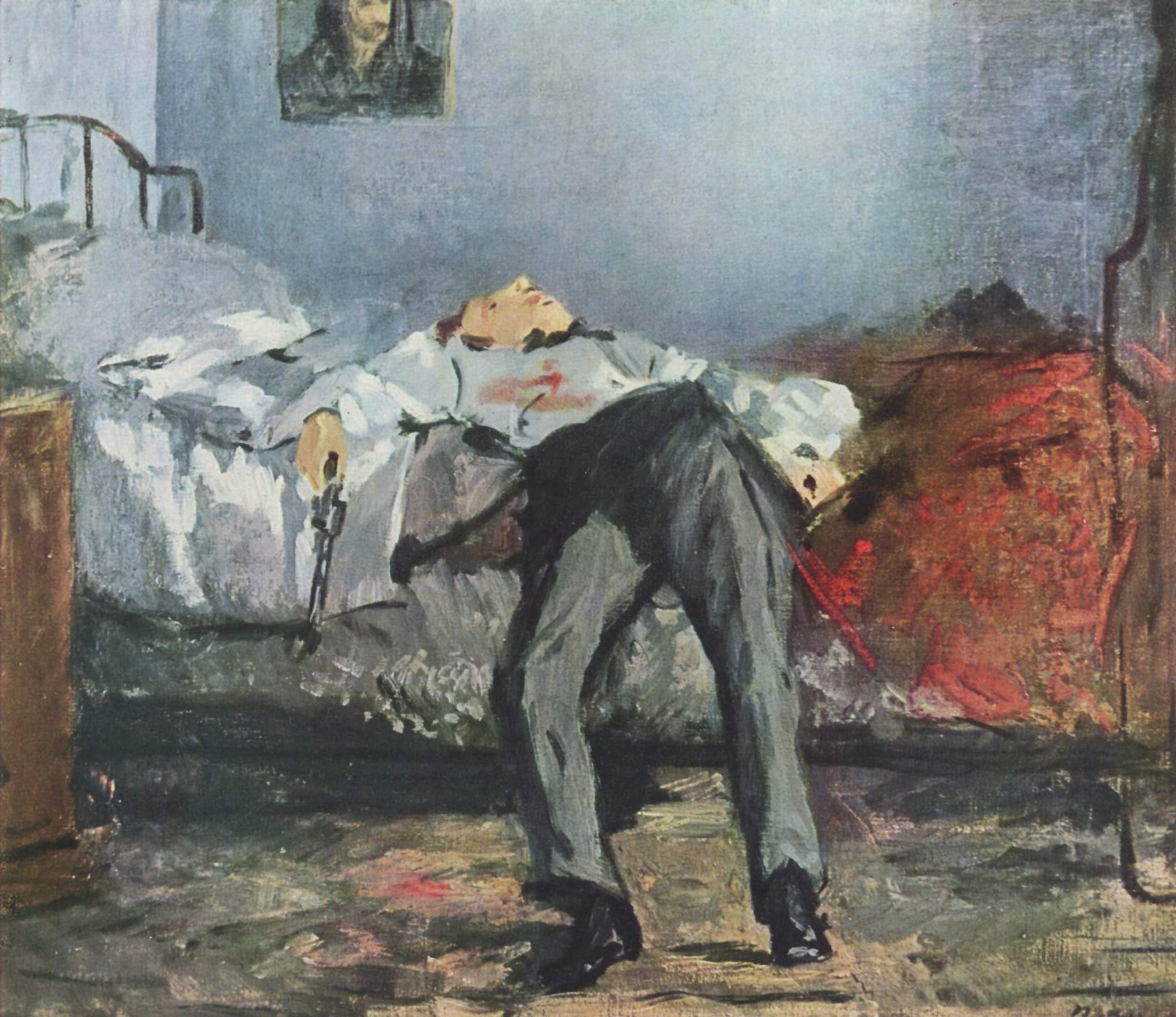
I have been fortunate to be an avid lover of the Arts. And, thanks to David Perkins and his highly recommended book "The Intelligent Eye: Learning to Think by Looking at Art", I was able to see the value of combining the Arts and Physix in my approach to teaching/learning Physix and to assist my students to grow as critical and careful thinkers.
The following activity is an illustration of such a nice marriage of the Arts & Physix. It involves a writing prompt (another way of connecting the students' learning in Physix with other areas of learning, English writing in this case) that introduces students to Scientific Methods, sharpens their critical thinking, and strengthens their listening and writing skills. 

*** Start of Activity ***

a) I hand students a little piece of paper each.
b) I display the two questions "Murder or Suicide? & What is your Physix-Based Evidence?" and ask students to use one side of the sheet of paper to   write their names, the date, and their responses to these two questions.  
c) In addition, I ask the students to use clues from the art piece itself (no Googling or Wikiing is allowed then) to guesstimate the general period of the art piece and the nationality of the artist.
d) I then display the following art piece, ask the students to use their clickers to pick one of the two choices (murder or suicide?) to collect data of their responses, and then give them the signal to start the thinking and writing processes. 

  
e) Once they are done, they stand so that I pair each student up with another student in class (think-pair-share) to discuss their respective responses and commit them to the other side of the same sheet of paper while making sure they write the names of their respective partners (to encourage listening, collaboration, staging an argument, and the value of citation.)
f) The papers are collected and then the students use their clickers once again to select an answer choice to gauge how much change in opinion did occur from pre to post discussion.
g) The class is shown the histogram distribution of their answers to the prompt but the actual answer is not shown (to build up some suspense) for it will be displayed in my reference/citation slide and long after all the slides that introduce and elaborate upon the concepts related to scientific methods.
h) The lively discussions, the intelligent arguments raised, and the preliminary Physix concepts used are the highlight of the activity!


*** End of Activity ***

Now, it is your turn!

1) Without looking up the source code of this web page, assume the role of one of my students, have a partner do the same, and go through the motions of the activity to test it.
2) In the comments area, share the results of your experience, your guesstimates, and the Physix of course!
3) Also comment on how you would use other art pieces to help your students appreciate art on one hand and connect Physix with art on the other hand?
4) I use other art areas in other contexts of coverage of Physix material (which I will share in future posts ISA), share what you do with your students.

Thank you and keep the Arts in mind while doing Physix for they are indeed a powerful educational pair!